Wednesday, June 16, 2021

The scooped out tree

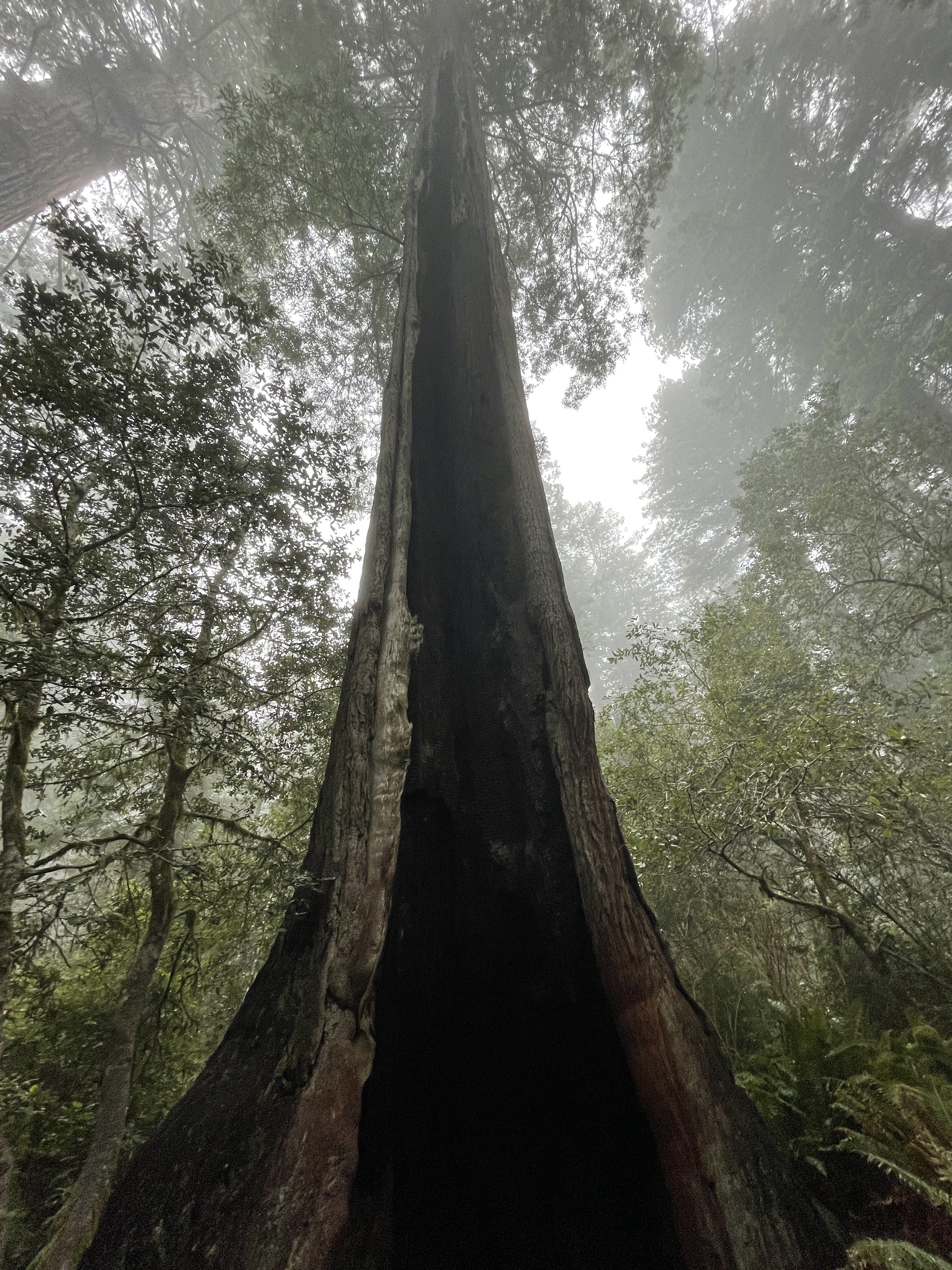
The tree stands tall, majestic, reaching out to the skies… and hollow. In its grandeur and strength, it stands there… oddly empty. Like someone has scooped out its insides, carved its innards, brutally, angrily, leaving it open, its void exposed, cavernous where its insides once stood… gaping. 

The thoughts that cross my mind may or may not be a result of binge-watching Criminal Minds as a family. The soundness of that decision and my good judgement I question with each episode. Sigh… but these are the thoughts that grip my mind as I gaze at the tree, hundreds of years old - broken, and yet whole.

I wonder how long it has been broken. I wonder what happened. Could it be heart break, a gut wrenching pain, a tragedy… travesty, despair, dashed dreams, lost love or friendship, unkindness… and other things that leave us feeling hollow and gutless within. Things that allow us to function, but nothing can ever completely fill the hole, the void, the emptiness… 

Things happen, shit happens… to most of us. How much it corrodes our insides varies from person to person, to how sensitive we may be, to the extent of the trauma, to how many different things we may have had to endure in the past – small things, big things, piercing things, even the slightest of things – there’s no knowing what will eat at our insides and to what extent.

I touch its grizzly bark. Every wrinkle, every fold has a story. What broke you, I ask the tree. What consumed your insides? Why you, and not the one standing next to you? The wise wrinkled bark has all the answers, I am certain. Yet, its hollow and brokenness will always be a mystery. I will never know the story.  

I move my gaze from the gaping hole to that which stands, that which holds, that which allows the tree to be every bit the tree it is.

I hold my breath. The idea of “brokenness” has no place in nature. It is only a narrative of what has happened, the life the tree has led, and that which it continues to do so… in flourish. Nature is cruel, nature is wise, nature has no room for pettiness, smallness or regret. It moves and continues to move. That is all it knows to do. That is all this tree knows to do. 

I move my gaze from the empty to that which stands, that which holds, that which allows the tree to be every bit the tree it is.

The parts that hold it are strong. The parts that hold the tree are unflinching. They have no time to miss their missing pieces. They do what they know to do and hold the tree and allow it to flourish and thrive, gaping holes notwithstanding. The branches widen above and reach to the skies - just as they were meant to. And that is all that matters. That is all that can ever matter. 


Friday, February 5, 2021

Poetry

Word after word on reams and reams of paper often fail to express what a swift, short poem will. Reams and reams of paper, with lines and lines of ink, will often fail to move us, the way a few short lines in verse will.

For a poem is a nugget of conciseness, of consciousness, holding together a scattering of ideas, experiences, emotions... Set often to rhythm and meter, that resonate with the beating of our heart, evocation of times and moments, of thought…

Last week, Literary Arts hosted a virtual talk by author, Madeline Miller. In talking about her craft, she mentioned that she often starts her workday by reading poetry. The succinctness of poetry helps her keep her prose tight and adhere to a certain economy of words, finding the choiciest and the most succinct.

For poets do that. They must. They compress into a few scant lines, reams of narratives, stories, feelings, and emotions.

I too have returned to poetry, ahem… even if my “art” has nothing to show for it. But in times of illness, when I did not have the energy to read pages and pages, when reading a few lines was all I could do - before my eyes closed, or nausea struck. With poetry, even if my eyes shut after a poem, or at times, after a few lines, the words and emotion carried further and longer than their sparse characters. It gave me the opportunity to remain surrounded by books and ideas, and the creative thought process. It allowed me a sense of normalcy when there was no semblance of any. In my heart and in my body. 

I too have returned to poetry, mostly unfinished, unpolished poetry. I seem to not complete it, to not finish saying everything I started out to. And while it would be nice to finish and polish the poems, with poetry, even in a finished poem, sometimes, you do not need to fill the blanks. The wholeness seems to come together, in its scattering, from the juxtaposition of ideas, from sparse strewn words, compacted with meaning and emotion.

It may be the blank spaces, the negative space in art, that draws the eye and the mind to that which is most important and moving.

I have no delusions of being any kind of a poet, trust me. But how can I forget the joy it brought me as a kid? In my childhood I wrote verses, with the clear and lofty literary goal to infuse in them, as much silliness as possible and incite as many giggles as possible. Move over Shakespeare. 

In school, whilst something way-more-important was being taught was invariably the most “creative hour” in this young poet’s life. Silly rhymes scribbled on chits of paper and passed around, to be received by muffled giggles to more “literary works” (sic) written in college classrooms. These masterpiece verses sometimes involved Baudelaire, Flaubert, Montesquieu et al, melodramatically lamenting, in their own genre, of course, the treatment that their oeuvres were being put through at our hands. Irreverent, metered, pointless and futile words, even if at-times intelligent – even if the intelligence, largely misplaced. Oh, the irreverence and arrogance of youth. Seems almost a delicious thing – noticed only when gone.

In Journalism school, I was surrounded by enough crazies, all very talented, of course, that the notes we passed in class, all in rhyme, the rhyme continuing as it passed, resulted in nothing short of literature.

Poetry has always been a part of my life, and I realized why when a friend recently commented on social media oh how our school (K-10, in India) forced poetry appreciation in English, Marathi and Hindi upon us. It was one of my most favorite part, surprisingly, in all three languages and I remember the slim poetry books we had in addition to our regular school curriculum.

Poetry recitation was also a thing and an expectation. We were required to learn poems “by heart” (as we called it) or to recite from memory. And as we grew older, and smarter (ahem), we got more creative. Wordsworth would most likely, turn in his grave to hear his beloved Daffodils, set to the music of the then Bollywood hit, Papa kehte hain, or Madonna’s True Blue - both work beautifully, by the way.

Our Marathi teacher insisted we put a tune to the poems (she also refused to teach us the tune), and that may be where this began. Boy, how we adapted. 80s music prevailed and renowned Marathi poet, Kusumagraj’s Saagar, was set to the Bollywood hit, Chehra hai ya… When asked to recite the poem, (I think it was part of our testing), I do vaguely remember standing in front of the class and belting out the poem Bollywood-ishtyle. Our teacher was okay with it (I think). I adored her and she instilled such love of poetry in me, even when we were singing it Bollywood-style.

I may not remember what I ate for lunch yesterday, but I spout random verses from my childhood. Some years ago, a friend started reading out a poem at a dinner gathering. I realized I still knew it “by heart”. Before I could hold my tongue, or my excitement, there I was reciting it, (such a showoff…sigh...). And as I got further into it, I realized I couldn’t do it without the Bollywood tune. Ahem… so I added that in as well (cringing now… Sigh…). Apologies to this friend, his calm reading of the poem would definitely, have been better than my-partly-set-to-Bollywood version.

Yes, poetry has always been a part of my life. And I can’t help wonder, if it is a dying art in today’s world? A dying art, in terms of appreciation, of relevance, of its lack in the educational curriculum. Yes, you can imagine the many eyerolls I receive from my teenager, each time I lament that they do not have enough poetry in their curriculum. Like a stuck record, I repeat, each time, how when I started learning English, it was the third language I was being introduced to, and yet, I have studied way more poetry than she has. Another eyeroll. Sigh…

Poetry, and art in general, have their place and always will. But will we consider it a thing of frivolity, and not serious-enough to deserve our energy and our attention?   

So, imagine my joy to hear that the absolute superstar poet, Amanda Gorman will recite poetry before the Superbowl. To see a poet receive the same stature of recognition and of coolness as a pop diva artiste.

For there will always be poets. There have been from the start of time. And there will be, till the end of time. That I know. For there are things that need to be said, there are emotions that need to be felt… and poets with their exquisite scattering of words take us there.

And as a way to apologize to Wordsworth for setting his beautiful poems to 80’s music, I will end with his quote, that says it all…

“Poetry is the spontaneous overflow of powerful feelings: it takes its origin from emotion recollected in tranquillity.” — William Wordsworth,
 

Thursday, January 14, 2021

Tilgul ghya… goad goad bola

Today is Makar Sankranti. A Hindu festival that celebrates the Sun. Although it is rarely sunny on January 14 (or January 15) in the part of the world I currently live in, the soul, the heart of the festival spreads warmth. Even when there is little outside.

My memories of festivals mostly revolve around food, the sweets in particular, the festivities, the people. I remember the making of tilgul, the super sticky jaggery, melted and mixed with toasted sesame (with coconut and peanuts in some recipes), flavored with a heady dash of cardamom. With palms greased with ghee, plenty of ghee, the balls are rolled out whilst the mixture is still warm, or smooshed and flattened into a large plate, to be cut into square, rectangles or my favorite, diamond shapes.

A word of warning about the warm gul (jaggery) and warm tilgul. Boy, does the sticky mixture hold heat! My tongue may still be recovering from the PTSD of my youthful tilgul delinquencies - ahem…of trying to get some before it cooled.

Dedicated to the sun, the festival marks the onset of warmer weather and longer days. While most Hindu festivals follow the lunar calendar and hence fall on different dates every year, Sankranti, is the only festival (that I know), that follows the solar system and the Gregorian calendar and falls on the same day every year (well, sometimes, a day difference).

In Maharashtra, tilgul ghya goad bola... is what you say when you give tilgul to one another. Translated literally, “Take this sweet, and speak sweet”. I suppose it signifies allowing sweetness into our lives, letting go of the dark and the grudges, of new beginnings amidst the increasing light.

Celebrated differently in different parts of India, the theme remains the same. The end of dark times.

Traditionally, these festivals hold their origins in harvest cycles and significances. And although not many of us will go out into our fields today, we could adapt them to the world around us and apply their significance to our current urban worlds, our political climates, our hopes and our humanity.

And while my mind was sweet and nostalgic this morning, with memories of tilgul, and the smell of warm gul (jaggery), scrumptious gulpolis, and even a blister or two from eating tilgul before it cooled, my mind was also entrenched in recent political events.

Earlier, I had started this poem and some rambling thoughts on recent political events. I may never complete the poem, and the rambling thoughts are probably incongruous in a piece filled with sweet memories and sticky sesame sweets. Yet, I will stick them right there… for after all, that is the life we live in. With all its duality.

 History repeats, they say,

With a shrug, insouciant

It’s happened afore

We’ll watch it unfold again

But who are the “they”

Can “they” be the “we”

who say no, to repeating history

To senseless actions

That destroy our peace

How long will we hide

behind complacent beliefs

That history repeats

 Leaders wield power. Even the weakest, the most cowardly, the most brazen. They hold in their hands, the ability to mobilize the masses. For at least someone will follow, without questioning the wisdom in the message, in the rhetoric, without forethought of its consequences.

Leaders wield power. Power to sway the masses. Mold minds. Influence the course of history. You don’t have to be a media studies student to know that it is simply a matter of repeating a message over and over till it seems true. Ask Goebbels or his ghost. Or the modern-day Goebbels that seem to crop up the world over. And we let them. For in our complacence, we have accepted that history repeats.

And even if the above thoughts are a jolt from the sticky sweetness of my nostalgia, I cannot find a better time, a better festival, one that celebrates the Sun and new beginnings to talk about recent political events with fervent hopes of more light and brighter days and new beginnings…

Tilgul ghya goad goad bola…


Thursday, December 31, 2020

Let me look at you 2020

We live in a world of contrasts, moving between shadows, in an unknown dance between light and dark, forming unseen patterns of intentions and inattentions.

For we cannot exist, only in the light, or only in the dark; the dance is constant, the patterns permanent, a combination of light and dark.

I think of times, of memories of goodness, and kindness, and humanity, and sometimes, they feel oddly heavy, for they are shrouded in a dark veil of events, exceedingly sad.

For even the most magical of tweezers cannot pluck away, only the good, the shiny, the golden, leaving to dust and decrepit, the unhappy, the wretched.

For in our life of contrasts, lie intertwined bonds, of happy and sad, of light and dark, they are but conjoined twins, they can never be only one.  

Let me look at you, 2020. You have been all that - with shadows scary, and hopes light and airy, I know I cannot remember one, whilst turning my back to the dark.

The yin and the yang of our existence, even when it frustrates, brings optimism and comfort; for even in the darkest times, there must come the light.

 ***

A year such as the one we have just had, begged for a pause and a little contemplation. I decided to jot down a few reflections that had flickered through my mind several times this year. Words flowed so swiftly, my typing could barely match their speed, as they hurtled through, in whatever quasi-poetry form they wished to ooze out in. 

Many many more thoughts remain whirling in my head about this incomparable year we have just had. As I am sure, they are swirling in yours. Truly, let me look at you, 2020!

  ***

 Ouroboros

This word, this haunting image, spirals through my mind all year. The tireless Ouroboros, the serpentine symbol of destruction and rebirth, the snake eating its own tail, destroying, recreating, reinventing.

The serpent is vicious, it destroys in haste. Pandemic, forest fires, lives on ventilators, burnout, lost jobs, businesses shuttered down, loneliness, deserted streets.

Yet, in its spiral, it remains a symbol of eternity and infinity and return. Of spirit, and survival and rebirth. Always returning, never stopping, never giving up.  

Let me look at you 2020, whilst terrifying and destroying, and bringing us to our knees, with humility and humanity, you bring strength, and faith to recreate, to reinvent, to not succumb and become dust.  

And even the thoughts of a menacing snake, cannot take away the circular of the ouroboros, of life, of continuity, of eternity, and a reminder, that we lay in a circle, this circle. Of destruction and rebirth.


Happy New Year!  


Friday, November 20, 2020

Okra and other scary monsters

 I rarely cook okra. There is a reason. However, reason at times, evades the mind.

I pick a bunch of ladies’ fingers or lady’s fingers (not sure which), as it is known in Indian English, from the grocery store. I wonder why I dread it so much. After all, I no longer gag while eating it. Ahem… if in a sentence, the word “gag”is strung so close to the vegetable… Enuff said, you say?

The day I decide to cook it, I must first tear myself away from my book – a retelling of Greek mythological events from the female mythical character’s viewpoint. As I cut the vegetable into neat, uniform, green circles, my thoughts remain immersed in the world of Gods and demons -murderous Medea, mystical Circe, enchantments and miracles, hexes and curses. I decide the vegetable name would fit well within Greek mythology - both the Marathi name, bhendi, and the English name, okra. Would it be a God, demon, nymph, monster, demi-god…my mind trails… I decide to move away from Greek allusions, but the spectacle in the pan before me tells me otherwise…

Just as in my book, the nymph Scylla is transformed into a scary monster, the crisp and clean green rings seem to mutate right before my eyes. Silky skeins emerge from their sides. Soon the skeins are ropes and they wickedly entangle the other okra pieces that refuse to emit the slime. Soon the poor innocents are entangled in their slimy grip and the evil energy of the slime seems to grow – in power and force and brutality… it takes on a life of its own…

I imagine it swelling and swaying, growing and moving, outside of the pan… the spell is cast and there is no return. Its slimy strings grow into long lengthy arms, snake-like arms, engulfing me, swallowing me up in its goopy gulp, and then move on to devour the dog, the sofa, members of my family upstairs, and finally the house.

Agreed, quarantine has been long and the imagination seems to be on steroids, but again, trauma by okra is very real. And it deserves its space and ink.

As I stand there, staring at it mindlessly, waiting for it to swallow me, I muster a little courage, a little determination… and a little lemon juice. Stop, right there, Okra! I’ll kill your goop with acid, my valiant inner Greek goddess arises to vanquish the monster.  I return from the fridge, armed with lemons, some dried coconut, and of course, as per my husband’s request, ground roasted peanuts. I add it all in, stir nervously, attempt to break the goop, and leave it to cook uncovered. I turn my gaze away, too scared to make eye contact with the monsters growing in the pan.

Slowly the slime is contained, the monsters lose their long slimy arms, the spell is destroyed, the hex is broken. The slimy monsters in the pan, give up, dry up and the green cut rings emerge victorious.

This is not a victory I had imagined would be mine. I had conceded defeat, yet moved through the motions, not with any particular hope. Or faith. There really had been no huge determination – mostly some revulsion, and a slow stench of impending defeat. And even if I continued to move through the motions, with no particular hope for success, it came. Slowly. Unexpectedly.

I wonder how many times, and how many things I go through with the same energy. And the same lack of faith. In myself. And in doing so, how often do I make the monsters bigger and stronger, giving them more powers than they may truly possess?  Slimy, Spiderman-skills, snake-like arms, multiple ferocious heads, and others, that a robust imagination conjures.

Yes, okra (and all you other monsters) - you have your powers, and yet, I have mine. Even when they may seem muted and muffled, in the wake of your spellbinding histrionics, even if, I am the one who make them out to be so mesmerizing and massive.

Next time, I hope I can turn and glance at, and have a little faith, in my own quiet strength and power, rather than the hypnotic alluring of the monsters before me… in the pan or outside.

And now that my head wears the laurels… it knows it is wise to keep an eye on the inner strength, and most importantly, it knows now… how to tame the okra.  


Monday, October 26, 2020

Sometimes things die… sometimes things change…

Sometimes things die. Sometimes they become something else. Sometimes, we are in a place where we witness it. Sometimes, we must live through it...

What do we do? Hold on like crazy to the old, or to the thought of the old, hoping fervently it won’t change? Perhaps… Or clutch on to it in our mind? Tight. Really tight. Eyes tightly shut, mind tightly closed, refusing to believe that anything can be different from the idea of what we hold? Of how things are, and will continue to be? Always…

Or do we wake up and face the reality and take stock of the change?

Who doesn’t love the metamorphosis of the drab caterpillar, transforming miraculously into a brilliant, scintillating butterfly? But what when we must watch the brilliant, scintillating butterfly turn into a drab worm?

Perhaps, that is 2020 for us.

Loss. Yes, the sense of loss has been imminent since the start of the pandemic. In small ways, in big ways - every person has a different story. And holding its hand, is grief. From the small, simple everyday things we take for granted, to all those big, wonderful plans.

But alongside, there has been a slowing down, and a solidarity, and a simplifying, and a renewed sense of what truly matters, and an ability to awaken to pleasures in the small joys, the little things, the simple enjoyments. Yes, 2020 you have been a mixed bag. You have taken away so much, you have taught us so much. 

These thoughts run through my head as we drive through the “ghost towns” in Eastern Oregon. 

Abandoned, derelict, they stand in shambles. But even while the decrepit walls crumble, they hold inside them stories. A history of an old, possibly glorious past. A past filled with hope, and possibility, of dreams, of riches and gold…

Gold was found in Sumpter, Canyon city, Granite, among other places during the gold rush of the late-1800s, and add to that, the Oregon trail and pioneers. As a result, several of these towns were booming, but were abandoned, once their industries were no longer prosperous, or when they failed to be part of a wider transportation plan.

Images of the wild wild west come to mind, and I imagine these dusty towns filled with prospectors and pioneers, speculators and traders, gold-miners and saloon owners…  

According to historians, about 256 such towns in Oregon became ghost towns. And just as they arose from the dust, they were eventually to be left in the dust…

Once again, I think of change, around us, so constant… Sometimes, it’s quiet and subtle, sometimes, it laps up up in big waves.

We drive further south into other remote, uninhabited parts of Oregon, all the way to the Alvord desert, which is now a crumpled and dried, alkaline river-bed.  

I look at the cracked and parched ground of the Alvord desert. It is hard to believe that this was once a lake, supposedly 100 miles long and 200 feet deep. What became of it? Of its power and force and form and energy?

And while my mind tries to recreate images of nature and a time bygone, I stop myself. I come back to the now and I pause, for I cannot but help wonder…

This beautiful desert in front of me – is it the butterfly or is it the caterpillar?


I wrote this before Oregon got engulfed in forest fires and smoke. It didn’t feel right to post this once the fires started and amidst news of burned-down homes. But I did want to share it, for really, the piece is about ghost towns, and perhaps change, and perhaps some of the ghosts we hold inside us… of our past, of that which we can’t let go, even when it’s long gone… and a new reality that is always emerging and standing before us, even when the ghosts lurk in the back…

For that is what recent histories and stories do… they make us notice things, and feel things… around us and sometimes, in a short instance, ever so fleetingly, inside us…


Wednesday, September 2, 2020

Alvord Desert: The desert sky

Nature marvels. It leaves us in awe. At times, all we can do is resign in its vastness and accept humility. Accept that we are insignificant in the limitlessness of its being. That we are powerless in the energy it exerts. That we are ignorant in light of the mysteries it holds. 

Standing under the stars in a desert reminds me of exactly that. Staring at a sky filled so choc-a-bloc with stars, I wonder if they have room to move.

An RV trip takes us to the middle of the Alvord desert in the Southeast of Oregon. I had often looked at that corner of Oregon with curiosity and Covid seems like the perfect time to explore remote, uninhabited parts of Oregon in a rented RV. Gears move swiftly in motion once I discover that it is possible to camp smack in the middle of the dessert as it is BLM (Bureau of Land Management)-managed land.

Our RV stands in the middle of the desert, in the middle of nowhere, without another soul for miles. We stand on the parched alkaline desert ground, with the Steens mountains on one side, and infinity on the other. A river once flowed here, and what now remains, is a large playa basin encrusted with salt mineral fissures. Silence engulfs us as we stand on the crumpled looking dry lake bed, and the world seems to slow down, just a little bit.

After dinner, we plant our chairs under the silence and the sparkle of the desert sky. The moon however, is rather bright as it is only a few days short of a full moon. We see the Milky Way, we see several planets and constellations that we normally cannot. We watch the International space station make it round.  We don’t need a flashlight as the stars and especially the moon is so bright and the parched yellowish cracked ground reflects it all.

I wonder how the desert sky would be on a new moon night.

I wake up around 4 a.m. to use the bathroom and happen to glance outside the window to remind myself of my surreal surroundings and current location. My jaw drops. The sky is a cluster of twinkling Christmas lights, crammed with stars. I step outside. The moon is gone and the stars are all out to play – every single one of them. Yes. The moon has gone to bed and the stars are dancing. They dance with a natural mirth and an ease of being and a knowingness of their place and power – they know who they are and what they can be – and all I can feel is awe, and perhaps a twinge of envy.     

My husband and daughter are sound asleep. I decide to wake them out of their deep slumber. We step out of the RV. It is 4 am. We do not need a flashlight. The stars shine bright and the earth holds the light.   We stand there mesmerized by it all. 

My daughter quips, “this is like a planetarium”. It certainly is. The Milky Way stretches out and sparkles with authority. My husband uses an App on his phone to identify constellations, and planets and galaxies. Yes, entire galaxies – visible to the naked eye. We marvel at the Andromeda galaxy and the Triangulum galaxy right in front of us.

I wonder what lies in these nebulous zones twinkling before my eyes. If that is an entire galaxy I am staring at, just how insignificant is the earth, and just how insignificant am I? I am not even a dot on my planet, and my planet is not even a dot in this immenseness before my eyes.

I want to learn astronomy, I want to know more about these stars and planets and the others that inhabit them. Surely, it can’t just be the 7.5 billion of us in this limitlessness glowing before me.

Yes. The sky is majestic. Nature is majestic. I am humbled by its grandness, its beauty, its power, its continuity, its never-ending, its never-stopping, its sheer force.

And even when I stand mesmerized in its awe, even when I feel humbled and tiny, I know that I am a part of it. That I am a part of this grandness, in my own, teeny, tiny, absolutely insignificant way. And we all are. And that we get to be a part of something so magnificent and beautiful is a beautiful thing. 


    Our "campsite" for the night

    Sunset over the Steens Mountains


    Puppy in the moonlight


    Sunrise over the playa


    More sunrise...

    Blogger silhouette whilst clicking pictures of the mountain :) 

    Sadly I do not have any pics of the night sky - will have to learn that skill :)